
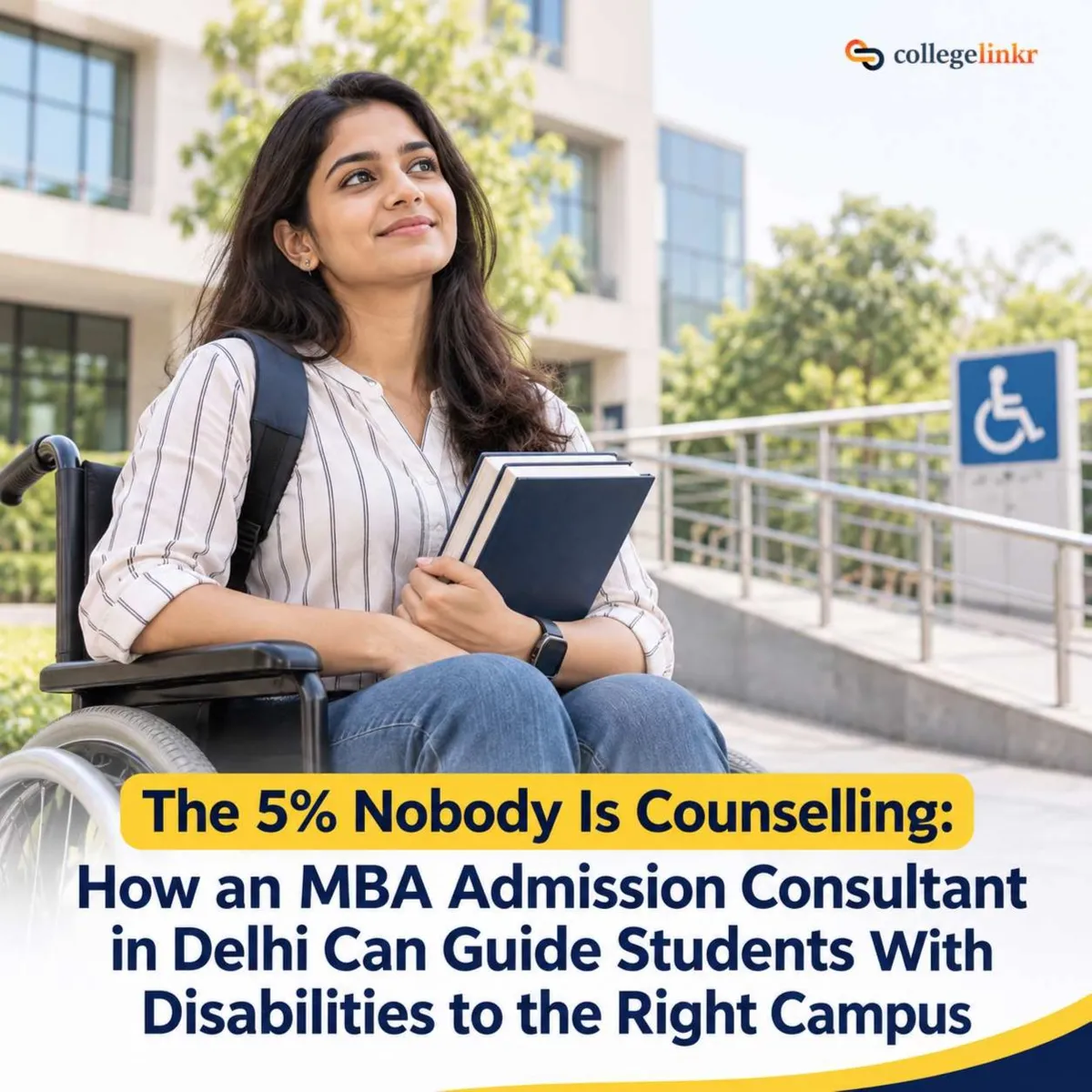
The 5% Nobody Is Counselling: How an MBA Admission Consultant in Delhi Can Guide Students With Disabilities to the Right Campus

Students with benchmark disabilities are legally owed at least 5% of seats at government and government-aided B-schools, yet they made up just 0.41% of CAT 2024 test-takers. Here's how Delhi consultants can counsel them properly, where colleges and consultanci…
A November Phone Call Most of Us Get Wrong
It's the third week of November. CAT 2026 is on 29 November, and a candidate from Laxmi Nagar calls you. She has low vision, a paper disability certificate from before the UDID system came in, and two questions. Will FMS accept that certificate? And does she get a scribe?
Most consultants say, "Check the website." It's the wrong answer. She's already checked the website. That's why she called.
Here's the number that should bother all of us. The official CAT 2024 results release from the IIMs says candidates with disabilities made up 0.41% of the 2.93 lakh people who sat the test. That works out to roughly 1,200 candidates. Meanwhile, Section 32 of the Rights of Persons with Disabilities Act, 2016 requires every government higher education institution, and every one receiving government aid, to reserve not less than 5% of its seats for persons with benchmark disabilities. And Census 2011 counted 2.68 crore Indians with a disability, about 2.21% of the population.
So the seats are there. The applicants aren't. Somewhere between a reserved seat and a confused family, there's real work for an MBA admission consultant in Delhi who's willing to learn the rules properly.
Delhi is a good city to do it in. Inside the city you've got publicly run programmes such as FMS at Delhi University, IIFT, the Delhi School of Management at DTU and the University School of Management Studies at GGSIPU. Across NCR sits the private belt: IMI, FORE, MDI Gurgaon, IMT Ghaziabad, BIMTECH. Those private schools generally don't receive government aid, so Section 32 doesn't bind them in the same way, and each one sets its own policy for candidates with disabilities. That single difference reshapes your whole shortlist.
Where MBA Aspirants Look for Help Now
Nobody starts with a consultant. A final-year B.Com student in Dwarka types "MBA direct admission Delhi" into Google at 1 a.m., skims a few listicles, joins two Telegram groups and DMs a senior on Instagram.
Her father runs his own search the next evening, usually something like "best MBA consultants in Delhi", and calls whichever number picks up first. Speed wins that call more often than quality does.
Candidates with a disability do all of that, and then a second, quieter search. Scribe rules. Compensatory time. Whether a 2019 certificate is still valid. Whether the hostel block has a lift. They read old forum threads and ask other disabled students on WhatsApp. Very few ask a consultant, because they don't expect one to know.
That's the gap. If your website and profile answer those questions in plain words, you become the MBA admission consultant in Delhi a tired family has been hoping to find.
One warning about that "direct admission" search. A management-quota seat at a private institute doesn't carry Section 32's reservation with it, and the government's Top Class Education scholarship only covers institutes that DEPwD has notified. Families rarely know this. Tell them before they pay a booking amount, not after.
Also Read
- Counselling in the Family’s Language: Why Regional-Language MBA Admission Consultants in Ahmedabad Win Trust First
- The College Already Has a Helpline. So Why Do Families Still Need You? A Field Guide for MBA Admission Consultants in Hyderabad
- They Call You an Agent. Here’s How MBA Admission Consultants in Chennai Become the Advisors Families Recommend
- How MBA Admission Consultants in Banglore Can Stand Out in a Crowded Market?
- Beyond Engineering and MBA: How Consultants Can Earn More From Niche, High-Demand Courses
Why Good Consultancies Still Miss These Students
It isn't a lack of goodwill. The process is just easy to fumble from both sides of the table.
The Admissions Office Has Its Own Headaches
Talk to anyone who's worked an admissions desk at a Delhi B-school and you'll hear a version of this list:
- Reserved seats need candidates whose papers are in order. A certificate that fails verification in the last week of admissions can't be fixed in time, and the seat sits in limbo.
- Accessibility questions ("Is there a ramp to the library?") land on a general admissions team that's never been asked to know.
- Old certificates keep turning up. DEPwD made the UDID portal the route for issuing disability certificates from 1 June 2021, and its own FAQ says people who already hold a certificate still need to apply on the portal. Plenty of candidates haven't.
- Most enquiries are generic. A college would much rather hear from one counsellor who sends a screened, document-complete file than from twenty students asking the same question.
None of this is a policy failure on paper. It's what happens when nobody owns the PwD file from start to finish.
And the Consultant's Side Isn't Easier
Now flip it. Most MBA consultants in Delhi work with a handful of colleges they've tied up with personally over the years. That's fine for a general-category candidate with a 92 percentile. It falls apart when a wheelchair user needs three campuses with accessible hostels and your list has two.
Then there's the chasing. You call an admissions office to ask how many PwD seats are in this year's matrix, and you're told to email. You email. A week goes by. Meanwhile the student has joined a WhatsApp group where someone answered in ten minutes. Wrongly. But quickly.
And when the file finally closes, you're often left asking the college when, or whether, you'll be paid for it.
What Students With Disabilities Expect From a Consultancy
It's a shorter list than you'd think. Here's what comes up again and again:
- Straight eligibility answers. The CAT 2026 eligibility notice asks PwBD candidates for 45% in graduation, against 50% for general candidates. It defines a person with benchmark disability as someone with not less than 40% of a specified disability, certified by the certifying authority. Say it in one breath. Don't make them read the PDF.
- A certificate check on day one, before you discuss a single college.
- Real accessibility detail: lifts, ramps, hostel washrooms, how far the classroom block is from the mess. Brochure photos don't count.
- Money answers. DEPwD's Top Class Education scholarship, as revised in September 2024, reimburses tuition and admission fees of up to ₹1.90 lakh a year for students with benchmark disabilities whose family income is up to ₹8 lakh. It only applies at notified institutes, so check the list before you promise anything.
- To be treated as an MBA candidate first.
That last one's underrated. A candidate with cerebral palsy and a 96 percentile wants to talk about finance electives and placement records, not just ramps. If every conversation circles back to the disability, you've lost them.
Getting Noticed Among Education Consultants in Delhi
Here's where I'll take a position. Don't add "PwD-friendly" to your Instagram bio and call it a strategy. Anyone can type that.
What earns attention is proof of homework. A one-page checklist for PwD MBA applicants. Short accessibility notes on the Delhi campuses you've actually walked around. A clear line on which institutes fall under Section 32 and which set their own rules. A named person who handles these files. Parents comparing the best MBA admission consultants in Delhi are scanning for exactly that kind of detail, and almost nobody offers it.
Pick a lane, too. Honestly, I'd start with one or two disability groups you can serve well, say low vision and locomotor disabilities, rather than claiming expertise across all of them. An MBA admission consultant in Delhi who's truly useful to visually impaired CAT takers will get referrals from that community far faster than a generalist will.
Why More Consultants Are Joining Networks
A solo consultant can't verify every college's PwD policy, chase every admissions office and still find time to counsel. Something gives. Usually it's the counselling.
That's a big reason many MBA admission consultants in Delhi now work through an admission network. CollegeLinkr is one. Membership is free, with nothing to pay upfront. Members are paid on confirmed admissions, and service charges are shown before you start rather than haggled over after. You get verified colleges across India in one place, you share application links straight from the app, and you can track each student from application to admission. Leads, applications, statuses and payouts sit on one dashboard. No admission targets. No territory rules. No fixed hours.
For an MBA admission consultant in Delhi taking on PwD candidates, the tracking matters most. These files carry more documents, more back-and-forth and more ways to stall. Seeing exactly where an application sits saves you the "any update?" calls that eat an entire afternoon.
I'd still make my own checks, mind you. A listing tells you a college is verified. It won't tell you whether the hostel lift works in July. Call and ask.
Outcomes First: IIM, ISB and XLRI Admits
Ask an aspirant what they want from a consultant and the answer usually comes in three letters. IIM. Then ISB, then XLRI, then a long tail of names their friends have heard of. Students judge MBA admission consultants in Delhi by admits before anything else, and wishing otherwise won't change it.
For candidates with disabilities, the outcomes conversation has a twist. The CAT notification states that 5% of IIM seats are reserved for persons with benchmark disabilities under the RPwD Act. ISB (which admits on GMAT or GRE scores) and XLRI (which uses XAT) are private institutions. As far as I know neither receives government aid, so Section 32's quota doesn't automatically apply to them. They may still offer accommodations. Ask their admissions teams directly and write down what they tell you.
So position your consultancy around outcomes, and be precise about them. "Three PwD candidates converted IIM calls this season" means something. "IIM-level guidance" means nothing. Haven't placed a PwD candidate at an IIM yet? Then say what you have done: interview calls, waitlist movement, scholarships secured. Honest small numbers beat inflated vague ones every time.
One-to-One Guidance, and How to Show It on Your Profile
Batch coaching teaches quant shortcuts to 200 people at once. It can't plan a mock interview for a candidate with a hearing impairment who lip-reads, or work out how a student with a specific learning disability should approach a written ability test. Section 17(i) of the RPwD Act talks about adjusting exams for students with disabilities, with examples like extra time and the facility of a scribe. Every candidate's version of that is different. Which makes it one-to-one work by definition.
So make it visible. On your profile, show:
- who'll actually sit with the student (a name and a photo, not "our expert panel")
- how many one-to-one hours each package includes
- a sample session plan, e.g. "Session 3: PI mock with captions on, recorded, written feedback within 24 hours"
- how you adapt PI and WAT practice for different needs
An MBA admission consultant in Delhi who shows this much detail is answering the question parents are too polite to ask: will you actually have time for my child?
Results People Can Check
Every one of the best MBA consultants in Delhi claims a success rate. Very few show the denominator. Here's how I'd present results so they hold up when a sceptical parent reads them:
- Admit numbers with context. A line like "11 of the 14 students we worked with converted at least one call" beats "92% success" every time.
- Success stories with written consent. Disability is deeply personal. Let the student decide whether they're named, initialled or anonymous, and leave the disability out entirely unless they want it in.
- Testimonials that say something specific, such as "they caught that my certificate had expired", rather than "very helpful sir".
- Before-and-after profile examples. Show a resume line before ("Handled operations at a logistics firm") and after ("Cut dispatch errors by 18% across two warehouses"). That one swap tells a reader more than a page of adjectives.
And skip "100% admission guaranteed." Families have seen it on every banner in Kalu Sarai. They don't believe it.
What the Fee Buys, and When
Fees are where trust breaks. If a parent can't see what they're paying for, they assume they're paying for nothing.
Name the Services Plainly
Write them out like a menu, with what the student walks away with:
- Profile evaluation: a written assessment of academics, work experience and gaps, plus a realistic target list.
- Shortlisting: 8 to 12 programmes, split into Section 32 institutes and private ones, with each institute's PwD provisions noted.
- SOP and essays: drafts and edits, with the number of revision rounds stated upfront.
- Interview prep: PI, WAT and GD mocks, run with the same accommodations the student will get on the day.
- PwD add-ons: a certificate and UDID check, accommodation requests for tests and interviews, a campus accessibility check, and help filing the Top Class Education application on the National Scholarship Portal.
Don't charge a "disability premium." Fold the add-ons into your standard packages. It's the right thing to do, and it's also how referrals start.
A Process With Dates on It
Parents who search "MBA admission consultancy Delhi" want two things on the first screen: a fee and a timeline. Here's a timeline that fits this cycle:
- Before CAT (August to November): certificate and UDID check, accommodation details confirmed. CAT 2026 is on 29 November.
- Results (December to January): CAT 2024 results came out on 19 December 2024, so plan for a similar window. Send the shortlist within a week of the score.
- Shortlists and interviews (typically January to April): WAT and PI mocks, plus a document folder ready for each institute.
- Offers (spring): compare offers on total cost, accessibility and each institute's PwD seat position.
- Scholarship: DEPwD invites Top Class applications through the National Scholarship Portal. For 2024-25 it announced the portal would open in June. Keep the admission letter and fee receipts ready before then.
Attach a deliverable to every step. "Shortlist document, two pages, by 5 January" is a promise people can hold you to. That's exactly why it builds trust, and why it makes your fee easier to justify.
"I Can Do This Myself"
Honestly? Some candidates can. The forms are online, the CAT notice is public, and plenty of disabled students have made it into IIMs without anyone's help. Don't argue with that. Answer the worry sitting underneath it.
"I can do this myself." Sure. Then ask one question: what happens if the certificate's rejected at document verification in March? Most candidates haven't thought about it. That's where you earn your fee.
"You'll just push colleges that pay you." Say how you're paid, upfront. Then point to the options on the shortlist that don't earn you a rupee. Nothing builds trust faster.
"I don't want to be labelled." Fair. Disclosure is their call. Reservation and formal accommodations only work with a valid certificate, though, so lay out what they gain and lose either way, and let them decide.
"Your fee is too high." Point to the itemised list. If they still think it's too high, maybe it is, for them. Not every family is your client.
An MBA admission consultant in Delhi who can't answer each of these in two sentences will lose the family to the next number on Google. Practise the answers out loud.
What to Do Before CAT Results Come Out
You've got roughly a month. Here's how I'd use it:
- Download the current admission brochures for FMS, IIFT and DSM at DTU, and read only the PwD sections. Note seat numbers, certificate formats and any interview accommodations.
- DEPwD's latest list of institutes notified for the Top Class scholarship comes next. It added 135 institutes in February 2024, so any older list you've saved is already out of date.
- Your one-page PwD checklist. Write it once, then pin it to your profile.
- Last, the CollegeLinkr side: set up your member profile, finish KYC verification, and send your first tracked application link to a student who's ready to apply.
Four things. Do them this month and you'll be ahead of most of the city.
Resources
Facts in this article were checked in November 2026 against the official sources below. Rules change every admission cycle, so confirm details with each institute's current brochure before advising a family.
- The Rights of Persons with Disabilities Act, 2016 (India Code, Government of India): Section 2(r) on benchmark disability, Section 17(i) on exam adjustments and Section 32 on reservation in higher education.
- CAT 2026 official website (Indian Institutes of Management): eligibility, PwBD provisions and test dates.
- UDID Project, DEPwD, Government of India: what the UDID card is, how to apply and the documents needed.
- DEPwD order revising scholarships for students with disabilities, 20 September 2024: current Top Class Education benefits and eligibility.
Want to share application links, track every PwD candidate's file and see your payouts in one place? Download the Collegelinkr App and set up your member profile before CAT results arrive.
Frequently Asked Questions
Start Earning With CollegeLinkr
Every admission season you wait is income left on the table.
Join a growing network of Members turning students into confirmed admissions.
Free to join · No targets · Paid on confirmed admissions