
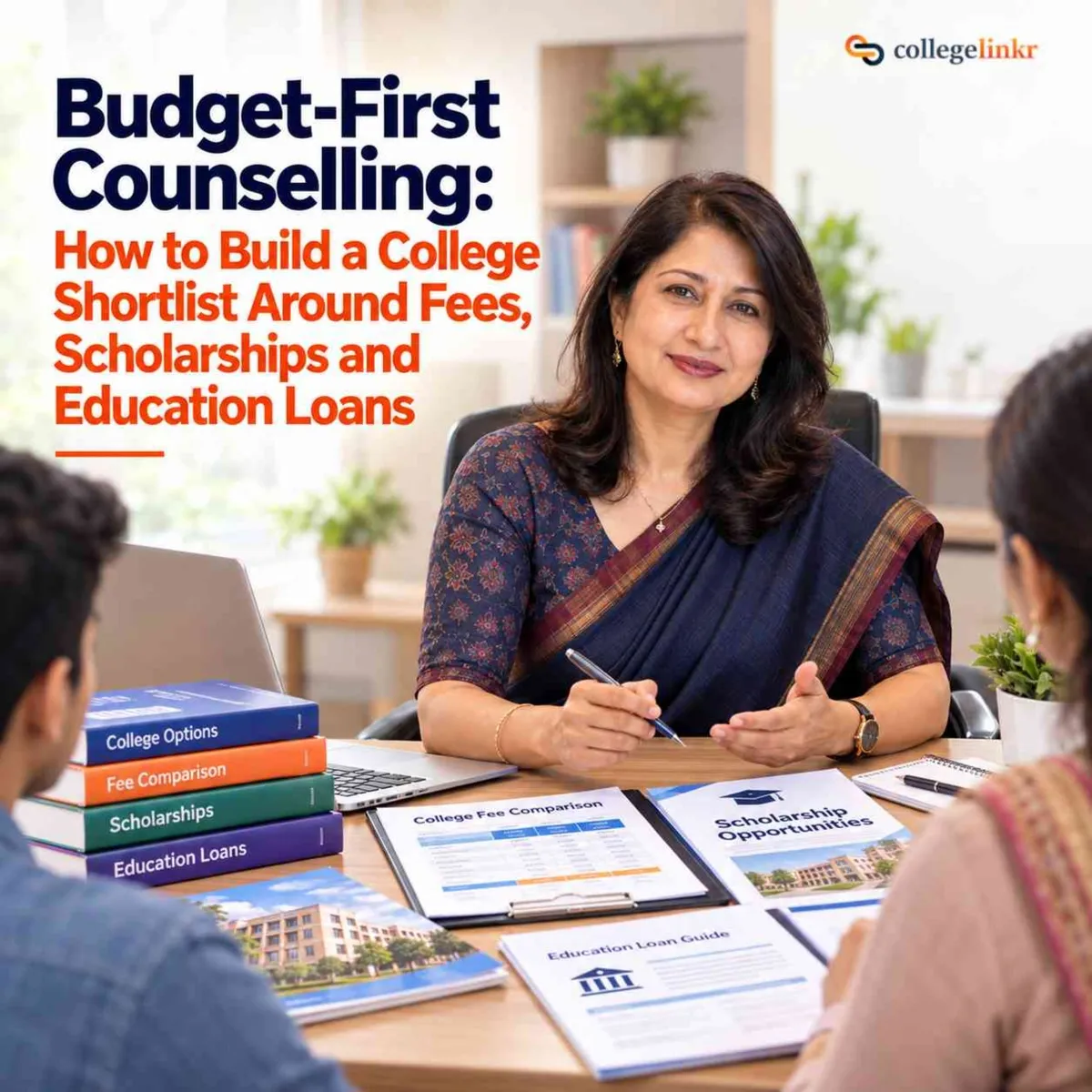
Budget-First Counselling: How to Build a College Shortlist Around Fees, Scholarships and Education Loans

Many admissions fall apart not because the student is wrong for the college, but because the family cannot afford it once the full cost becomes clear. Budget-first counselling fixes this. This step-by-step guide shows admission consultants how to understand a …
When the Dream College Becomes a Dropout
It happens every season. A consultant spends hours helping a student choose a college. The student is excited, the application goes through and the seat is confirmed. Then the family sees the full fee sheet, with hostel, mess, exam fees and deposits, and quietly withdraws.
Everyone loses. The student loses a seat and time. The family loses confidence. The consultant loses an admission and sometimes a referral. And often, the real problem could have been spotted in the very first conversation.
Budget-first counselling turns the usual order around. Instead of finding the best college and then asking about money, the consultant starts by understanding what the family can afford and builds the shortlist from there.
Why Families Struggle to Talk About Money
Many parents hesitate to share their income or savings, especially early in a conversation.
They underestimate the full cost
Families often focus on tuition and forget hostel, food, travel, books, exam fees and deposits.
They do not know what help is available
Many families have never heard of the National Scholarship Portal or government-backed education loan schemes.
They hope it will somehow work out
Some families agree to a college they cannot afford, hoping to arrange money later. That hope often runs out at the fee counter.
A consultant who handles this conversation sensitively provides one of the most valuable services in the whole admission process.
Also Read
- Run Your Entire Consultancy From Your Phone: Managing Leads, Applications and Payouts in One App
- Top Campuses, Small Office: How Consultants Can Offer Premium Universities With Ease
- Small Consultant, Big Portals: How CollegeLinkr Helps You Compete With Aggregators
- No Targets, No Time Limits: Why Quota-Free Partnering Suits Admission Consultants
- Low Marks, Missed Counselling or a Gap Year: How to Find the Right College for Students With Difficult Profiles
- Beyond Engineering and MBA: How Consultants Can Earn More From Niche, High-Demand Courses
- Zero Investment, Zero Risk: Why a Free Admission Network Beats Paid Franchises and College Tie-Up Fees
Step 1: Have the Budget Conversation Early
Ask about budget in the first or second conversation, gently and without judgement.
- "To suggest the right colleges, it helps to know what range is comfortable for your family each year."
- "Would you be considering an education loan, or would you prefer to manage with savings?"
- "Is studying away from home possible, considering hostel and travel costs?"
Explain that you ask so you can protect them from surprises later. Most families appreciate it.
Step 2: Calculate the Full Cost of Each Option
For every college you consider, build a simple total cost picture.
One-time costs
- Admission or registration fee
- Refundable caution or security deposit
- Kit, uniform or equipment for practical courses
Yearly costs
- Tuition fee
- Examination and university fees
- Hostel rent and mess charges
- Transport or travel home
- Books and materials
Full programme cost
Multiply the yearly costs by the number of years and add the one-time costs. Show families both the first-year cost and the total for the course. A college that looks affordable in year one can become difficult over four years.
Step 3: Explain Refund Rules Before Any Payment
Families need to know what happens if plans change. Under UGC's fee refund policy for 2024-25, institutions had to give a full refund for cancellations up to 30 September, with a deduction of no more than ₹1,000 as a processing fee up to 31 October. Later admission schedules follow UGC's 2018 refund notification. Rules can be updated for each session, so check the current circular and the college's written policy before advising families.
Knowing their money is protected helps families commit with less anxiety.
Step 4: Factor In Scholarships
Scholarships can change which colleges are realistic.
The National Scholarship Portal
The National Scholarship Portal brings together many central and state schemes in one place. Students need a One Time Registration (OTR) number, a 14-digit number generated using Aadhaar that remains valid for their entire academic career. For the 2026-27 academic year, the portal opened from 1 June 2026, and students may apply for one merit-based scheme and one or more welfare-based schemes, depending on eligibility.
College scholarships and fee waivers
Many colleges offer merit scholarships, sibling discounts or need-based concessions. Check these for every college on the shortlist.
Prepare documents early
Income certificates, category certificates, bank details and Aadhaar seeding are often required. Ask families to arrange these before scholarship deadlines approach.
Step 5: Explain Education Loans Clearly
For many families, a loan makes a better college possible.
PM-Vidyalaxmi
The PM-Vidyalaxmi scheme, approved by the Union Cabinet in November 2024, enables collateral-free and guarantor-free education loans for students admitted to eligible Quality Higher Education Institutions. The loan can cover the full tuition fee and other course-related expenses. Key features include:
- A 75% credit guarantee from the Government of India on loans up to ₹7.5 lakh
- 3% interest subvention during the moratorium period on loans up to ₹10 lakh for students with annual family income up to ₹8 lakh, for up to one lakh students a year
- A single PM-Vidyalaxmi portal for applying for loans and interest subvention
Eligibility depends on the institution. At launch, the scheme covered institutions ranked in the top 100 of NIRF's overall, category or domain rankings, state government institutions ranked 101 to 200, and central government institutions, beginning with 860 institutions. The list is updated every year, so check whether a shortlisted college qualifies.
Existing interest support
Under the PM-USP Central Sector Interest Subsidy scheme, students with family income up to ₹4.5 lakh pursuing technical or professional courses from approved institutions receive full interest subvention during the moratorium on loans up to ₹10 lakh.
Be honest about loans
A loan is a long-term commitment. Help families understand repayment and choose a loan size that matches realistic career outcomes for the course.
Step 6: Build a Three-Tier Shortlist
Once you know the budget and the support available, organise options into three groups.
Comfortable
Colleges the family can afford from savings or income without stretching.
Stretch with support
Colleges that become affordable with a scholarship, fee waiver or manageable loan.
Aspirational
Colleges slightly above budget that may be worth exploring if significant support comes through.
Present the shortlist with the full cost and the support assumptions clearly written for each option. Let the family decide with clear eyes.
Step 7: Keep Checking Until the Student Joins
Costs and support can change. Confirm scholarship applications, loan approvals and fee deadlines regularly until the student has joined and settled.
Common Mistakes in Fee Counselling
- Sharing only tuition fees and ignoring other costs.
- Recommending colleges without checking total programme cost.
- Assuming a family will get a loan without checking eligibility.
- Forgetting scholarship deadlines and institute verification steps.
- Pushing a family to stretch beyond what they are comfortable with.
How CollegeLinkr Helps Consultants Counsel on Budget
CollegeLinkr gives Members access to more than 400 verified colleges across India, with course details, eligibility and fees in one place.
- Compare fee structures across colleges quickly while building a shortlist.
- Find options in different price ranges, including colleges in other cities and states.
- Share application links and track each application in real time, so cost-related issues can be handled early.
- Earn service charges on confirmed admissions, with transparent payout tracking.
- Join for free and get support from onboarding to payout.
Accurate fee information from one source means fewer surprises for families and fewer withdrawals for consultants.
Final Thoughts
Budget-first counselling is not about limiting a student's dreams. It is about making sure the path they choose is one they can actually complete.
When consultants talk about money early, calculate the full cost, explain refund rules and bring scholarships and loans into the conversation, families make decisions they can stand behind. Those families confirm their admissions, stay the course and come back with referrals. That is good for students, good for colleges and good for every consultant who wants a lasting practice.
Resources
- Cabinet approves PM-Vidyalaxmi scheme (Ministry of Education)
- National Scholarship Portal (Government of India)
- UGC announces new fee refund policy for higher education institutions (All India Radio News)
Want to build shortlists families can actually afford? Download the CollegeLinkr App to compare fees across verified colleges, share application links and track every admission until the student joins.
Frequently Asked Questions
Start Earning With CollegeLinkr
Every admission season you wait is income left on the table.
Join a growing network of Members turning students into confirmed admissions.
Free to join · No targets · Paid on confirmed admissions